If you have arrived here, there is a good chance you have received news you did not expect. As an expectant or new parent you have been told your child has Down syndrome.
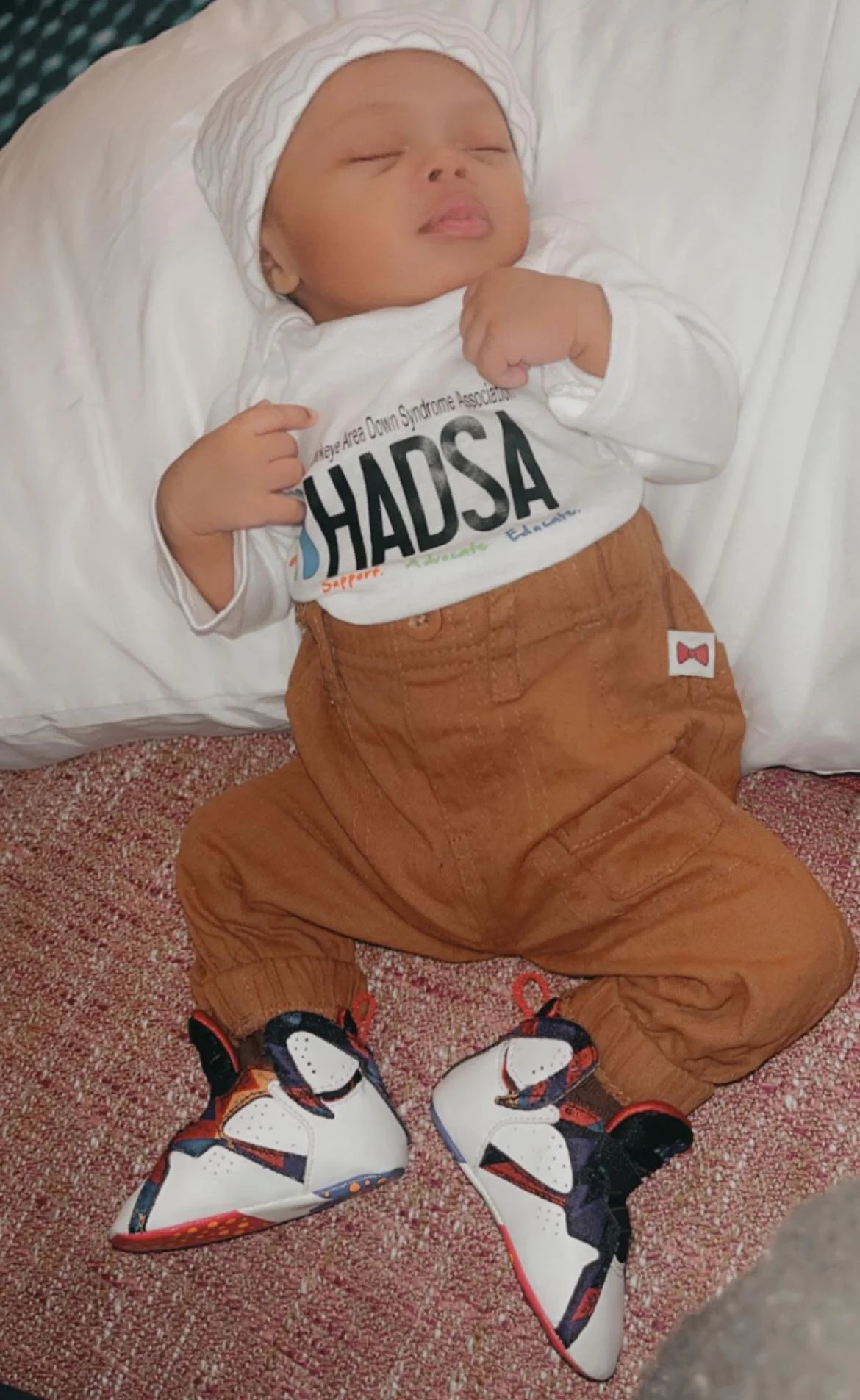
If your child has arrived, please accept the sincere congratulations of our entire community.
Whether you are celebrating the birth of your child or anticipating its arrival, here you will find the basic information you need to get started on the rewarding processes of having a child with Down syndrome in your life.
As you embark on this passage,
HADSA offers two thoughts.
First, you are not alone. Instead, you have become part of a large, deeply caring and warmly welcoming community. When you are ready, please contact us at info@hadsa.org. We can answer what seem to be terribly daunting questions and, if you like, put you in contact with other parents who have been exactly where you are now. We can promise you will find them supportive, knowledgeable and above all sensitive.
Second, take care of yourself. Whether you are expecting or have been joined by a new arrival, the one thing that is known is that a baby – a little packet of human potential just waiting to explore his or her world – is counting on you. So, rest, relax and enjoy.

Written By: Emily Perl Kingsley
I am often asked to describe the experience of raising a child with a disability – to try to help people who have not shared that unique experience to understand it, to imagine how it would feel. It’s like this …
When you’re going to have a baby, it’s like planning a fabulous vacation trip – to Italy. You buy a bunch of guide books and make your wonderful plans. The Coliseum. The Michelangelo David. The gondolas in Venice. You may learn some handy phrases in Italian. It’s all very exciting. After months of eager anticipation, the day finally arrives. You pack your bags and off you go. Several hours later, the plane lands. The stewardess comes in and says, “Welcome to Holland.” “Holland???” you say. “What do you mean Holland??? I signed up for Italy! I’m supposed to be in Italy .. All my life I’ve dreamed of going to Italy.” But there’s been a change in the flight plan. They’ve landed in Holland and there you must stay. The important thing is that they haven’t taken you to a horrible, disgusting, filthy place, full of pestilence, famine and disease. It’s just a different place.
So you must go out and buy new guide books. And you must learn a whole new language. And you will meet a whole new group of people you never would have met. It’s just a different place. It’s slower-paced than Italy, less flashy than Italy. But after you’ve been there for a while and you catch your breath, you look around … and you begin to notice that Holland has windmills, Holland has tulips, Holland even has Rembrandts. But everyone you know is busy coming and going from Italy … and they’re all bragging about what a wonderful time they had there. And for the rest of your life, you will say “Yes, that’s where I was supposed to go. That’s what I had planned.” And the pain of that will never, ever, ever, ever go away … because the loss of that dream is a very, very significant loss. But…if you spend your life mourning the fact that you didn’t get to Italy, you may never be free to enjoy the very special, the very lovely things …. about Holland.
Welcome to Holland
Person-First Language
Use this language when referring to Down syndrome and people who have Down syndrome.
People with Down syndrome should always be referred to as people first. Instead of “a Down syndrome child,” it should be “a child with Down syndrome.” Also avoid “Down’s child” and describing the condition as “Down’s” as in, “He has Down’s”
Down syndrome is a condition or a syndrome, not a disease.
People “have” Down syndrome, they do not “suffer from” it and are not “afflicted by” it.
Down vs. Down’s
NDSS uses the preferred spelling, Down syndrome, rather than Down’s syndrome. While Down syndrome is listed in many dictionaries with both popular spellings (with or without an apostrophe s), the preferred usage in the United States is Down syndrome. This is because an “apostrophe s” connotes ownership or possession. Down syndrome is named for the English physician John Langdon Down, who characterized the condition, but did not have it. The AP Stylebook recommends using “Down Syndrome,”as well.
While it is still clinically acceptable to say “mental retardation,” you should use the more socially acceptable “intellectual disability” or “cognitive disability.” NDSS strongly condemns the use of the “R” word in any derogatory context. Using this word is hurtful and suggests that people with disabilities are not competent.